















In the first installment of this series, coatmaker Bob Bigg told us what Savile Row was like in the 60s, 70s and 80s, when he was working there. The big houses weren’t the same necessarily, and it wasn’t all high end. But Sean Connery and Roger Moore were on the piss.
Today, we move away from celebrities to some different aspects – the drink, the characters and the sharp practices.
Bob started as a coatmaker in 1968, and is still working part time for Whitcomb & Shaftesbury. He worked for many tailors over the years, including people like Anthony Sinclair, Ronnie Prescott and Harry Helman.

PS: Bob, what were some of the sharp practices that went on around Savile Row?
Oh there was lots of that – there were some great salesmen around. One of the best was Ronnie Prescott, the cutter at Adeney & Boutnoy, where I worked for a while.
Prescott used to say to me in the afternoon, “It’s a bit quiet, I’ll go out and drum up some work.” And he’d go to Bentley’s or a club like that, and bring back a load of people. They’d be drunk as drunk. They’d carry on drinking at ours, and at some point later they’d all totter home.
Then the next day he’d phone them up and say, “Now, that chalk-stripe suit you ordered, was it single breasted or double?” And they’d have no recollection of ordering it – he just made it up.
Although to be fair, he’d often be a little subtler than that. They’d order two suits and he’d say it was three, perhaps. They were all very rich men, there was no problem with money, it was just a question of getting the order out of them.
Did they ever get something and not like it because they didn’t order it?
Yes that happened, and worse – one time I remember someone coming in carrying a new suit he’d received, and Prescott saying, “Is there anything the matter? I thought that suit was nice, it fitted well.”
And the customer replied: “Yes I know it fitted well. But I didn’t like the cloth the first time you sold it to me,” and he opened up the suit to show the exact same one inside, “and I don’t like it any better the second time!”

Was drinking a big part of the culture back then?
Oh yes, many of the cutters were drinking every day. I remember a customer once ordering a suit and then, as he was leaving, shouting back to Prescott “and I want a morning cut, Ronnie!” because he’d go out drinking at lunch every day and the afternoon’s weren’t – in the customer’s view at least – as good as the morning’s.
Harry Helman was a great cutter, but his shop at that time was on Bruton Street and he had a back door down into the Guinea [Guinea Grill, a pub]. His brother always complained that Harry was always drinking and he did all the work – but it was a good combination, it was Harry that people came in to see.
What were drinking clubs?
They made tailors popular! Pubs usually shut at three o’clock and wouldn’t open again until five or six. But you’d have these customers from out of town, who’d come in to see their accountant, their banker, their tailor. Then they’d go out to lunch, get a bit of the taste, and want to carry on drinking – but nowhere was open.
So they’d go to a drinking club, a member’s club, and the tailors were members there. It was the kind of place you needed to be recommended to, so again these out-of-towners needed someone to sign them in. There were about 10 I used to drink in.

In some of the clubs you didn’t need to sign in, you just had to look the part. I used to play squash in the RAC (below) every week, and I just strolled in. I was always smart so that helped.
One time a member came up to me and he said ‘You!’ and I thought, ‘Oh I’ve had it now, I’ve been found out’. But all he said was: ‘You! Look I know you’re on the committee, because I always see you hanging around. Could you help me raise this thing with them…’
You’d never get away with that now, all those clubs are much tighter.
What were the workshops like back then?
They were big, lots of people, very busy. Everyone was on piece work [paid per item they made] so they never really looked up from their work, just talked with their heads down.
In fact that was why the whistling started – you know about the whistling?
No, what was that?
It’s hard to explain, but there was this whole system of whistles so people could comment on things as they were working. The most common one was if someone said ‘He’s such an idiot’ then everyone would whistle back in unison as if to say ‘Well you’re a bigger idiot’. So to avoid that you had to say ‘He’s an idiot, barring’ which meant ‘barring me’, accepting you’re an idiot too, then they couldn’t whistle back.
I love it, it’s like a whole system of banter for people that aren’t looking at each other.
Exactly. It sounds silly but when you’re in a big workshop and it’s shooting around, it gets to be very funny.
And you’d have coatmakers and apprentices in there?
Usually apprentices would train elsewhere, but sometimes yes. After a four-year apprenticeship you’d maybe go into a bigger workshop as an ‘improver’ for two years. You’d sit with a coatmaker and learn from him, and get perhaps 40% or 60% of the money for the piece, with the rest going to go the guy you’re learning from.
It’s a long time isn’t it?
Yes, but you’re still learning. And my thing is always, I don’t care how you get there, I just care what the result is like. So it’s good to learn and try different methods. I’ll show you how I want the edges of the collar to roll and how I do it, but you can do it a different way if it works for you.
How did the style of suits vary over time?
The 60s was very boxy, high buttoning and without much shape. It got more interesting in the 70s and 80s, because people wanted more style. Into the 80s in particular, people wanted to look rich, so they showed off with their tailoring. There was lots of demand, everyone was making loads of money.
Who were the characters around, people like Hardy Amies, Edward Sexton?
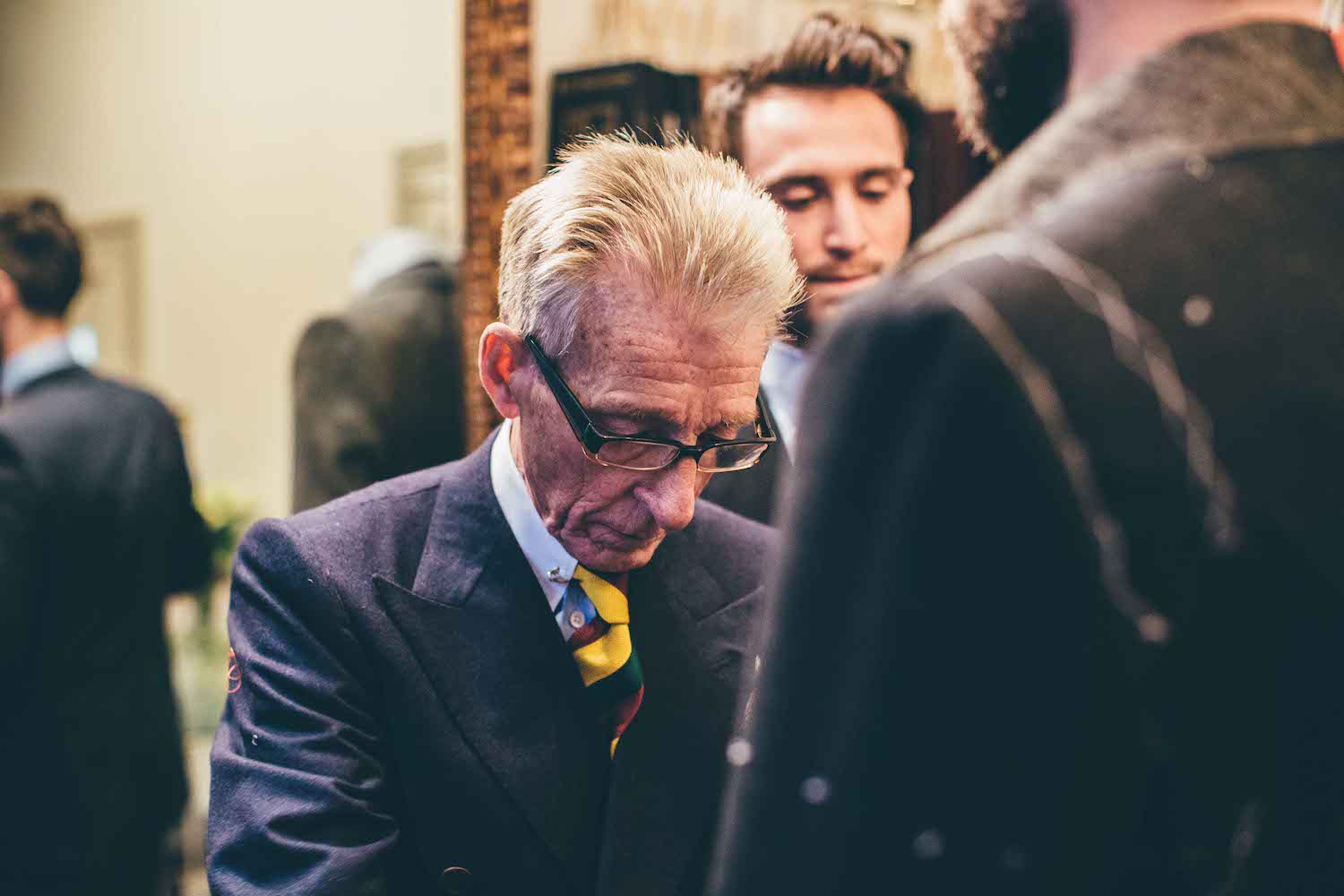
Amies had been around for a while, but he was always immaculate. Sexton (above) was great, such a good cutter. Whether you liked his style or not was a different matter, but he was very good.
Were there big differences between the house styles?
Not big ones, Sexton was unusual in that regard, but the customer was more knowledgeable and they’d know the difference. Kilgour for example had this heavy drape – a firm suit but with strong drape, and a cut right through the front.
I think people get too hung up on these details though. The important thing is not the fit so much, or the make, as to how it makes the customer look. Don’t start picking apart the fit, just think about whether he looks good.

How much difference does having a good front-of-house make?
Oh a lot, there used to be some great ones. Colin Hammick (above) was great, as was Tommy Nutter. They looked fantastic in their clothes, always. It’s something that’s missing a lot today.
Hammick was a bit crazy though, so meticulous. You’d say ‘I like the fit of this jacket’ and he’d say ‘I don’t. The shoulders are a clear eighth of an inch too wide.’ And he’d make you take it apart and do it all again. Customers really took after him though, he’d inspire them.
Prescott was the same, 6 foot 3 and always immaculate. Never anything out of place. Some of them had their hair cut every Monday, so it looked the best all week long. Every thing looked was how you’d want to look.
Because they were so perfect they could get away with more unusual clothes. They’d wear this gorgeous cloth and you’d think ‘I wish I could look like that’. But of course you wouldn’t look the same.
Prescott had a white-silk suit – there was a tiny check in it, very hard to make. He kept it hanging up in the summer, and if he was going out to lunch with someone special he’d put it on. It looked very impressive.
Did they try to sell the most expensive cloths?
Often, though there were techniques around that as well. I remember when the Super 100s first came out, Prescott had the bunch sitting on the side, open. He’d show the customer the usual Smith’s or Lesser’s 13oz, but you could see the customer admiring the 100s. ‘Cor, this is nice Ronnie,’ they’d say.
‘It’s too expensive,’ was all Ronnie said. Implying, of course, that it was too expensive for the customer.
That got them interested: ‘Well how much Ronnie?’ they’d ask. ‘Oh, about £150 more [around £2000 today]’, and of course they’d end up going for it.
Thing was, next time they went in, the normal cloths would be that price. ‘Well that was what you paid last time,’ he’d say!
Was it ever the case that customers knew what was going on, but didn’t mind?
Yes absolutely. These were intelligent men and a lot of those relationships were quite playful. And as I said money wasn’t an issue. This guy was one of the richest men in the world at the time.

Were any customers especially difficult?
We’d call those ‘Mayfair customers’. They’d often be very demanding and not have much understanding of what we did. Those are the kind of people you’d end up pretending to make adjustments for – often you had to, because they didn’t really know what they wanted.
They’d bring in a piece to be altered, and you’d give it a steam and a brush, but not change it. Next time they came in, you’d put it on them and immediately say ‘Oh no, we’ve over done it haven’t we? Yes we’ve overdone it.’
You’d take it off them and again not change it, just give it a brush down. Then the last time they came in, you’d say ‘Oh yes, much better, glad we made that change.’ And they’d walk away happy.
Love it. I know shoemakers have a trick where they spit in the bottom of a shoe, then bang it around in the back of the shop to pretend they’re working on it. Then they give it back and, because there’s more friction inside, the customer thinks it has been changed.
Yes some of them used to put talcum powder inside to do the opposite, to make it feel smoother. There was one cutter, when he had a ‘Mayfair customer’, who would put a whole load of chalk marks all over the fitting, then call to his assistant: ‘I’ve marked all the alterations, take this to Mr Brush downstairs!’

Do you get characters like that much in the trade these days?
No I don’t think you do, all the kids now take it very seriously. You ask them these days when a jacket can be ready, and they look very carefully at their calendar on their phone, and tell you ‘Wednesday at 2pm’. When I was working, you just took on everything they gave you, and got it done when you could.
That feels like it’s part of the trend we were talking about last time – that the top end is what’s left of the industry today.
Yes I think that’s fair, although there are some things that are lacking, like the front of house and keeping up with ready-to-wear.
There was a big wave of young people who wanted to get into the industry after the 2008 financial crisis, wasn’t there? Historically it was more working class, often immigrants; now it’s middle class and younger, perhaps more idealistic.
Yes, which is good in many ways; the issue is their expectations and how many stay.
Let’s hope many do and it spells good things for the industry. Thank you for your time, Bob, it’s been both enlightening and a lot of fun.